RT-Splatting: Joint Reflection-Transmission Modeling with Gaussian Splatting

CVPR 2026 (Highlight)

Peking University

Abstract

3D Gaussian Splatting (3DGS) enables real-time novel view synthesis with high visual quality. However, existing methods struggle with semi-transparent specular surfaces that exhibit both complex reflections and clear transmission, often producing blurry reflections or overly occluded transmission. To address this, we present RT-Splatting, a framework that disentangles each Gaussian's geometric occupancy from its optical opacity. This factorization yields a unified surface-volume scene representation with a single set of Gaussian primitives. Our hybrid renderer interprets this representation both as a surface to capture high-frequency reflections and as a volume to preserve clear transmission. To mitigate the ambiguity in jointly optimizing reflection and transmission, we introduce Specular-Aware Gradient Gating, which suppresses misleading gradients from highly specular regions into the transmission branch, effectively reducing distracting floaters. Experiments on challenging semi-transparent scenes show that RT-Splatting achieves state-of-the-art performance, delivering high-fidelity reflections and clear transmission with real-time rendering. Moreover, our factorization naturally enables flexible scene editing.

Method

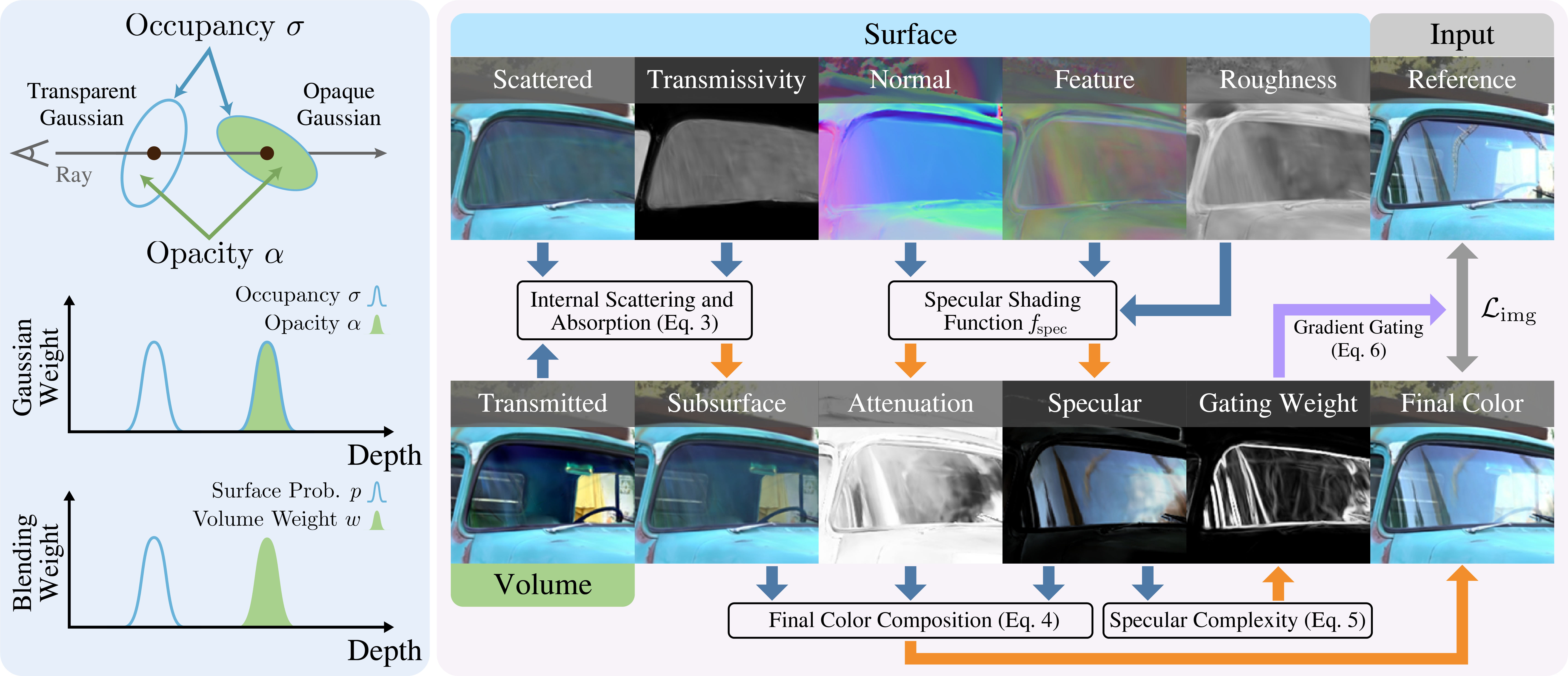
Overview of RT-Splatting. Our method tackles semi-transparent surfaces by factorizing the standard Gaussian opacity into geometric occupancy and optical opacity, which explicitly decouples a surface's physical presence from its visual transparency. This enables a hybrid rendering pipeline: a deferred pass extracts surface attributes for sharp reflections, while a volumetric forward pass accumulates clear background transmission. Finally, we composite both layers for the final output, and jointly optimize the scene with a Specular-Aware Gradient Gating to prevent reflection artifacts from corrupting the background.

Visual Comparisons

Here we demonstrate side-by-side videos comparing our method to top-performing baselines across different captured scenes.

Select a scene and a baseline method below:


Interactive visualization. Hover or tap to move the split.

Our method preserves smooth reflections on the semi-transparent windows and clear transmission through them. Baseline methods either treat the transparent surface as opaque or fail to reconstruct the smooth reflective surface.

Our method preserves smooth reflections on the semi-transparent windows and clear transmission through them. Baseline methods either treat the transparent surface as opaque or fail to reconstruct the smooth reflective surface.

Our method preserves smooth reflections on the semi-transparent plastic film while maintaining clear transmission through it. Baseline methods fail to reconstruct specular reflections and often introduce many floaters.

Our method preserves smooth reflections on the semi-transparent windows and clear transmission through them. Baseline methods either treat the transparent surface as opaque or fail to reconstruct the smooth reflective surface.

Our method preserves smooth reflections on the semi-transparent windows and clear transmission through them. Baseline methods either treat the transparent surface as opaque or fail to reconstruct the smooth reflective surface.

Scene Editing

Here we showcase scene editing results with side-by-side comparisons between each edited output and the original rendering.

Select an editing operation below:


Interactive visualization. Hover or tap to move the split.

The tinting edit gives the clear film a warm amber tint while keeping the film reflective and transparent.

The opacifying edit reduces transmission, making the film appear frosted and more occlusive.

The clearing edit removes the windows entirely, providing a clear view of the car interior.

The mirroring edit turns the windows fully opaque, eliminating transmission and making the glass mirror-like.

Citation

@inproceedings{RT-Splatting,
  title     = {{RT-Splatting}: Joint Reflection-Transmission Modeling with Gaussian Splatting},
  author    = {Shi, Ji and Ying, Xianghua and Xing, Bowei and Guo, Ruohao and Yue, Wenzhen},
  booktitle = {CVPR},
  year      = {2026},
}